UTAH BLOBSQUATCH? Teenagers filming what they say they think is a bear, until it stands, and they run. Blobsquatch? I'll let you decide........


Sierra Tahoe Bigfoot Research

This site is dedicated to the research of bigfoot, and it's habitat, in the Tahoe and outlying Sierra region of Nevada and California. We listen to witnesses who want to talk about their experiences, and keep them confidential unless otherwise requested. Our mission is to learn as much as we can about the possible existence of the sasquatch, in the hope that we can all gather a better knowledge of the species, then ultimately, we as a race understand that it's habitat, and way of life, must be protected.


Showing posts with label bear safety. Show all posts
Showing posts with label bear safety. Show all posts
Monday, November 5, 2012


Friday, June 8, 2012
Bigfoot: A Trip into the Sierras
A fellow sasquatch enthusiast, Barry, contacted me a few months back, and we traded some ideas back and forth in regards to him wanting to take a trip up to the Sierras to do some scouting around. He was gracious enough to share some pictures for us to enjoy of a couple trips he took over the past few weeks.
Though he didn't have any interaction, he did come across an interesting tree break that he didn't notice until he got home. Below is a great game cam picture, where he captured a picture of a coyote, but also on the right side of the photo, there is a small pine tree with the top snapped and hanging down. It is a rather sharp break that could be explained as snow load, but because of the nature of the clean break, I think it could have been snapped by other means. Nonetheless, it is a great photo.

Desolation Wilderness game cam pic with coyote and tree break on the right (Click on Pic to Enlarge)
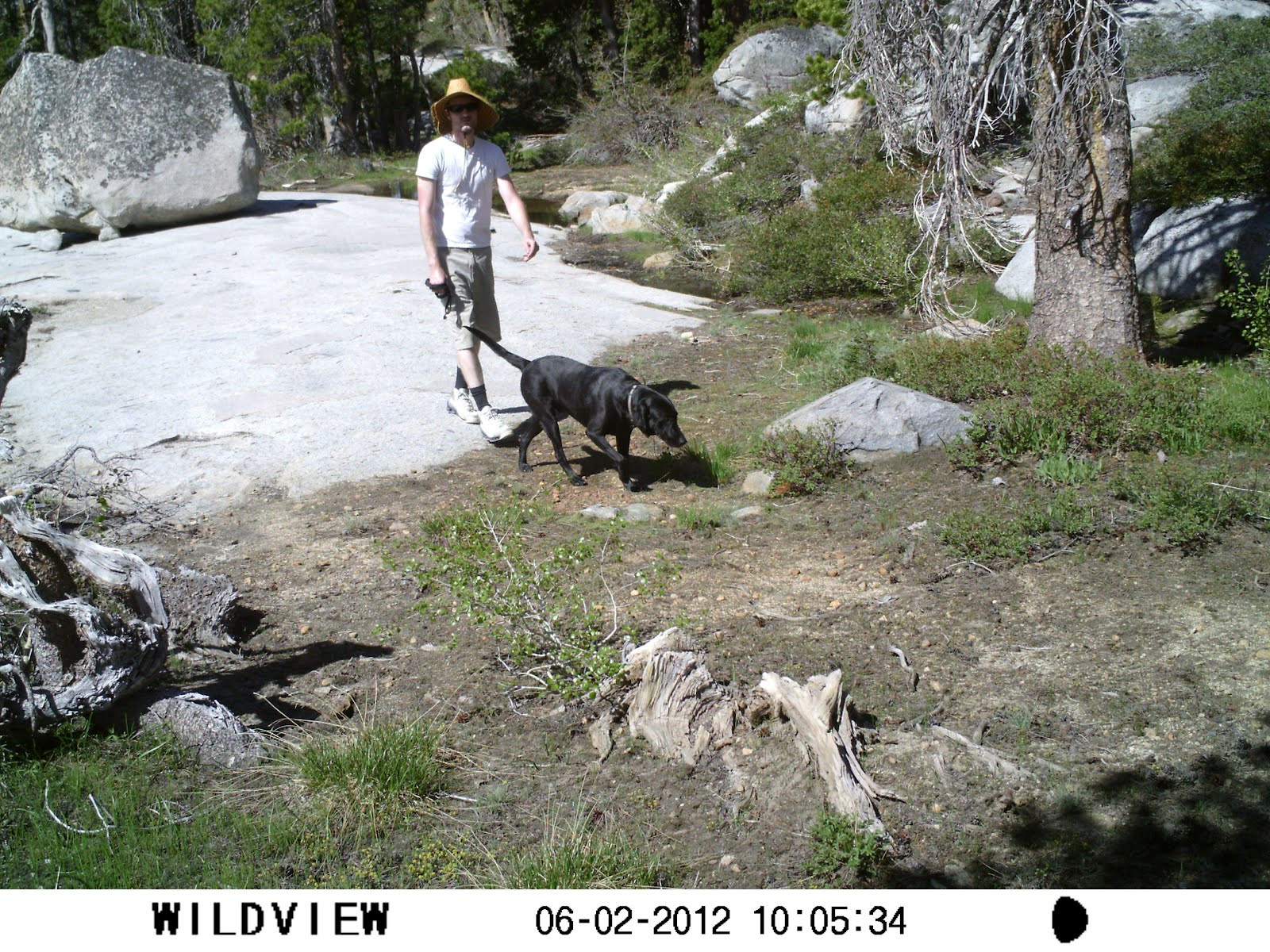
More of Barry's photos from the Desolation Wilderness, south of Lake Tahoe, from the weekend of June 2, 2012:

Clearing where Barry set a game cam to watch for deer (Click on Pic to Enlarge)

A picture that made Barry do a double take, showing how shadows and twisted shapes can sometimes play tricks with you while you are out there (Click on Pic to Enlarge)

Barry and his lab, Enzo, retrieving a game came. Barry pointed out that there are many granite formations in the area with numerous streams crisscrossing the maze rocks (Click on Pic to Enlarge)
The previous weekend of May 26th, Barry and his fiance Jen, took their dogs out to an area near the San Joaquin River. There was snow coming down one day, and Spring sunshine the next, showing the power of mother nature, especially in the Sierras. This just drives home the point, that when venturing out, you should always be prepared for extremes in weather.

Snow falling on the say to Mono Hot Springs (Click on Pic to Enlarge)

Sun and shorts weather the next day. Jen, Enzo, Abby and Barry (Click on Pic to Enlarge)
I want to thank Barry and Jen for sharing their pictures with us. I'm always glad to show off the beauty, and the sheer squatchiness of the Sierra Nevada Mountains.
Though he didn't have any interaction, he did come across an interesting tree break that he didn't notice until he got home. Below is a great game cam picture, where he captured a picture of a coyote, but also on the right side of the photo, there is a small pine tree with the top snapped and hanging down. It is a rather sharp break that could be explained as snow load, but because of the nature of the clean break, I think it could have been snapped by other means. Nonetheless, it is a great photo.

More of Barry's photos from the Desolation Wilderness, south of Lake Tahoe, from the weekend of June 2, 2012:


The previous weekend of May 26th, Barry and his fiance Jen, took their dogs out to an area near the San Joaquin River. There was snow coming down one day, and Spring sunshine the next, showing the power of mother nature, especially in the Sierras. This just drives home the point, that when venturing out, you should always be prepared for extremes in weather.


I want to thank Barry and Jen for sharing their pictures with us. I'm always glad to show off the beauty, and the sheer squatchiness of the Sierra Nevada Mountains.
Wednesday, June 6, 2012
Take the Kids Squatchin!
My buddy Woodrat has been taking his daughter, "Lizard" squatching since she was a baby. Now she's getting ready to graduate 1st grade, and loves getting out in the woods and mountains with her dad, more than anything.
Woodrat doesn't get far off the beaten path with her. He keeps it within her limitations. You don't need to get far off road to get near the bigfoot. Most sightings occur as they cross a road, right?
Here are some pics from one of their recent trips to the northeast Sierra Nevada Mountains:

Lizard in her camo gear

Woodrat looking for tracks on the wet road

Our good friend "Granpa Don" went along too

Lizard off exploring
Woodrat doesn't get far off the beaten path with her. He keeps it within her limitations. You don't need to get far off road to get near the bigfoot. Most sightings occur as they cross a road, right?
Here are some pics from one of their recent trips to the northeast Sierra Nevada Mountains:


Sunday, November 13, 2011
Bigfoot: More On Squatching Safety From A Reader
Someone posted some good advice under the comments on Sasquatch"ing" Tips: Safety First
Anonymous said...
"Regarding the topic of Sasquatch field research safety I have a few thoughts to add.
I base the following on a wealth of personal experience in the deep wilderness, much of it rifle and bow hunting in pursuit of elusive big game. I have spent entire seasons off the grid and apart from civilization for seasons on end. BTW I make no apologies for hunting, it is an honorable pursuit and I have never taken any trophy animals that were not eaten either by my family or donated to a food bank. For the record too; I am of Algonquin descent.
The preceding post on safety afield is all good advice—but I would add the following in regards to dangers often underestimated or even made light of.
Bear safety; This subject is misrepresented by many outdoor “experts”. I frequently see comparisons made between the chances, (probabilities), of being killed by a bear and say; being killed by a bee or lightning strike. In making such statistical arguments (comparisons) the “experts” are comparing “apple and oranges” instead of making factual statistical comparisons. Every human in the U.S. is exposed to common dangers such as lightning strikes, dog attacks, motor vehicle accidents and bee stings etc. Only a tiny sampling of US residents avail themselves of the possibilities of a bear attack. The two sample groups cannot be equitably compared in the same statistical grouping since they are not evenly populating the sample studies. When accurately compared the probability of being attacked, injured, fatally injured changes dramatically. This is one of the common misunderstandings that lulls people into a set of careless behaviors in the woods.
Another common misrepresentation is the arrogant “Timothy Treadwell” attitude fostered by nationally televised “nature” specials” so popular with today’s armchair naturalist.
Timothy Treadwell (not his real name) held himself out as a protector of Katmai’s coastal brown bears, supposedly protecting the bears from “poachers”. What poacher ? Since the mid 1950’s the Katmai National Park has never had a single incident of poaching. Treadwell was but a fraud; guilty of negligent homicide, in the case of his girlfriend Amie. Treadwell and Amie were both killed and devoured by a large brown bear he had named “Satan”. But all that’s another story.
The point is bears are totally unpredictable. Their also cunning, highly intelligent, thoughtful, vicious predators capable of running in excess of 35 miles per hour.
Surprisingly more people are severely injured , killed and eaten by black bears than brown or grizzly bears. There are reasons for this and the field expedition member should understand the entire topic of bear attack before going into the woods, (especially overnight)
While the scope of this post is well beyond the brevity of what I can write here: there are ways to minimize risks inherent to sharing the woods with these magnificent creatures; such as: Each field researcher should always carry a large can of bear spray such as UDAP’s 13.4 oz. product. Practice cans with inert product are available as practice is paramount to using it effectively in an emergency. There are many other easy, cost effective precautionary measures regarding bear safety. There is a wealth of information available to anyone so interested, and good, factual information is the best defense available.
All field researchers should read Steve Herrero’s well researched book; Bear Attacks: their Causes and Avoidance. The book is still considered to be the best available text regarding the subject."
I do carry a can of Bear Spray. It is a great piece of advice that I forgot to mention.
Thanks for the comment.
Subscribe to:
Posts (Atom)
LinkWithin
